Tools for Wood Joinery
Essential Hand Tools for Wood Joinery
Hand tools offer unparalleled precision and control, and they are vital for fine-tuning joints, even in a power-tool-heavy shop.
- Chisels: Indispensable for detail work, cleaning out mortises, shaping wood, and fine-tuning edges. They come in various sizes and need to be kept sharp for precise cuts.
- Hand Saws: Used for various cuts, a set including a rip saw (for cutting with the grain), a crosscut saw (for cutting across the grain), and a backsaw (like a dovetail saw for fine joinery) is beneficial.
- Planes: Hand planes, such as a block plane or smoothing plane, are used for flattening, smoothing, and shaping wood surfaces and can help in flush-trimming proud joinery.
- Clamps: A wide assortment of clamps (bar clamps, C-clamps, handscrews, etc.) is crucial for holding pieces together securely while glue dries or while working on them.
- Marking and Measuring Tools: Accuracy in joinery starts with precise layout. Tools include a tape measure, combination square, marking gauge, and a marking knife or pencil.
- Mallet/Hammer: A wooden mallet or hammer is used to drive chisels, nails, and dowels and help assemble joints.
Proud joinery refers to a technique in woodworking where one component of a joint intentionally sticks out past the surface of another, rather than being flush. Often used for aesthetic, rustic, or structural effect, this style leaves pegs, dovetails, or tenons slightly raised to highlight craftsmanship, create visual texture, or prevent tear-out.
Common Power Tools for Wood Joinery
Power tools significantly increase efficiency and are essential for many modern woodworking projects, particularly when dimensioning lumber or making repetitive cuts.
- Table Saw: Often considered the heart of a workshop, it offers precision for straight cuts, ripping, crosscutting, and making various joints with the right jigs and blades (e.g., dado stacks).
- Router: Extremely versatile for edge treatments and joinery work, including cutting dados, rabbets, and, with specific bits and jigs, dovetail and glue joints.
- Jointer/Planer: These machines work together to flatten and thickness lumber, creating straight and square edges and faces necessary for accurate, tight-fitting joints.
- Biscuit Joiner (Plate Joiner): A specialized tool that cuts crescent-shaped slots for inserting flat, oval "biscuits" to create strong, fast joints, especially useful for plywood and panel projects. An example is the
- Drill (Handheld or Press): Used for drilling holes for dowel joints or pocket screws. A drill press offers more accuracy for straight holes.
- Pocket-hole jigs and dovetail jigs are used in conjunction with drills or routers to make specific joints easier and more accurate.
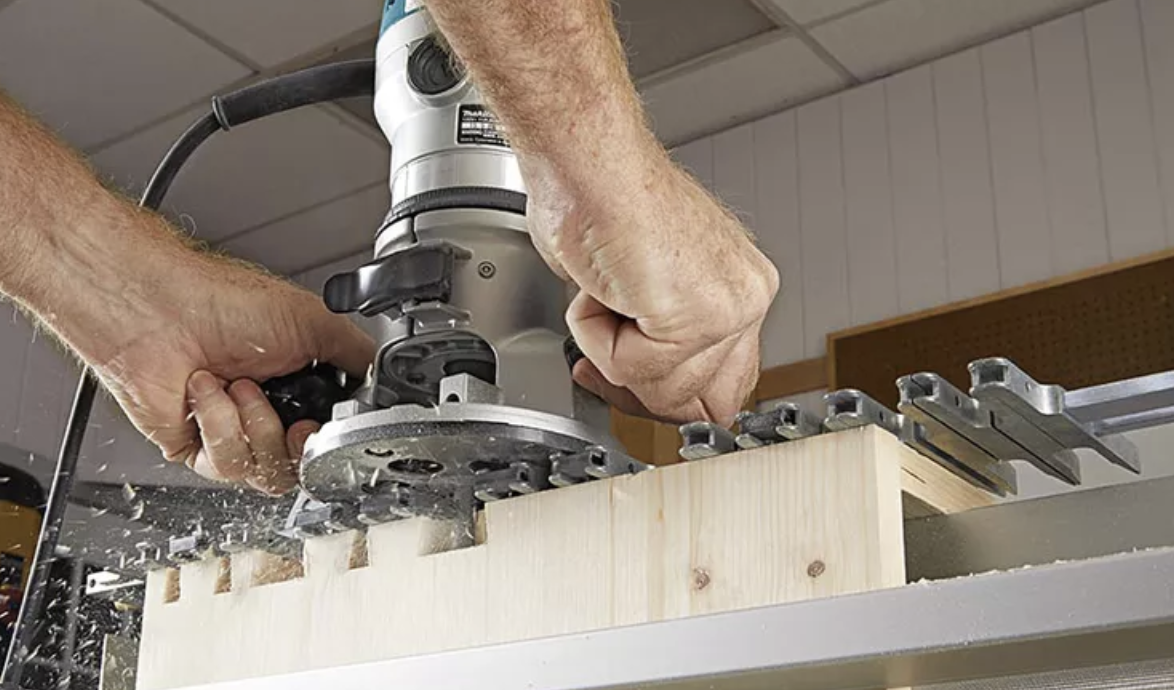
Here is an example of a jig for making dovetail joints.
An attractive style of visible joint that has a history of hundreds of years.
Wood joinery tools also have variations in jigs for simple and more complicated joints such as dovetail joints. Some jigs are very simple and some more advanced.
Also, some jigs may cost more but include everything you need to make dovetail joints and others may not include some things like the type of router bits you will need.