Different Types of
Wood Joinery
If you’re getting into woodworking (or you’ve been at it a while), learning **different types of wood joinery** is one of those things that can make every project look more professional, more durable and more interesting.
Here’s the big idea: some joints are chosen because they’re **easy and fast**, some because they’re **crazy strong**, and some because they’re **decorative** (or all three). The good news—and this is the part people don’t always realize—is you can **show how simple it is to do many wood joints** with a few basic tools and some practice scraps.
Before we dive into specific joints, it helps to know what makes a joint strong: lots of long-grain-to-long-grain glue surface, a shape that resists racking (twisting out of square), and good fit. End grain doesn’t glue as strongly as long grain, so many “strong” joints either avoid end grain bonding or add a mechanical lock (like pins, dovetails, or shoulders).
Click here to see the web page for common tools used for wood joinery.
The Different Types of Wood Joinery
Only Have 100% Strength
with Good Glue
Glue is also very important. For most indoor projects, a quality **PVA wood glue** (like Titebond Original/II-type products) is the everyday go-to: strong, easy cleanup, and forgiving. For higher water resistance (outdoor-ish exposure), a more water-resistant PVA is common; for true outdoor longevity, **epoxy** is often the best. **Hide glue** is traditional (and reversible with heat/moisture—great for repairs), and **polyurethane glue** can work but is messier and foams, so it’s not usually the first pick for tight joinery.
A quick rule of thumb: glue doesn’t replace joinery, it complements it. A well-fit joint with the right glue is dramatically stronger than a sloppy joint with “extra glue.” Most PVAs like snug joints and moderate clamp pressure; you want a thin glue line, not a starved joint from over-clamping.
Now for **tools for wood joinery**—you don’t need a museum of equipment. A basic kit is: tape measure, combination square, marking knife or sharp pencil, clamps, a decent saw (hand saw or circular saw), a drill/driver, and chisels. From there, specialty tools make certain joints easier: a router (dados/rabbets), a table saw (repeatable joinery), a miter saw (clean angles), a pocket-hole jig, doweling jig, biscuit joiner, or a mortiser.
The Simplest Wood Joint
is The Butt Joint
Let’s start with the simplest: the **butt joint**. This is just one board butting into another—end grain into long grain is common. Construction is straightforward: cut pieces square, align, glue, and clamp. On its own it’s not the strongest, so it’s usually reinforced with screws, nails, dowels, biscuits, pocket holes, or corner blocks.
The easiest “upgrade” to a butt joint is the **screwed butt joint**. Pre-drill to avoid splitting, add glue on the mating face, and drive screws. It’s fast and great for shop fixtures or utility builds, but you’ll often hide screws with plugs, caps, or by placing them where they won’t be seen.
A super popular beginner-friendly method is the **pocket-hole joint**. You drill an angled pocket and drive a special screw into the mating board. Construction: clamp the work, drill pocket holes with a jig, apply glue (optional but recommended for furniture), and screw together. It’s quick, strong in many face-frame and cabinet applications, and requires minimal clamping time.
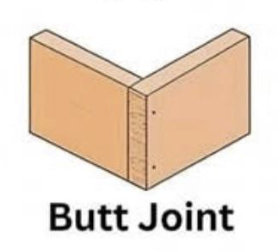
The simplest joint in wood joinery techniques is the butt joint.
With screws and good glue, it can still be pretty strong and can also be reinforced with another piece of wood on the inside if space allows.
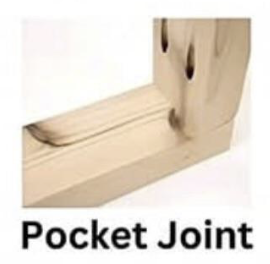
There are jigs you can buy for making accurate pocket joints.
A lot of people would put the screws in from the bottom board straight into the top board and screws straight into an end grain do not hold very well.
This type of fastening makes a butt joint much stronger.
The Lap Joint
Next up: the **lap joint** family—simple, strong, and forgiving. In a basic half-lap joint, each board has half its thickness removed so they overlap flush. Construction: mark the overlap, cut the shoulders and waste (table saw, router, or handsaw + chisel), test fit, glue, and clamp. Because it gives long-grain glue surface and a mechanical “step,” it’s far stronger than a plain butt joint.
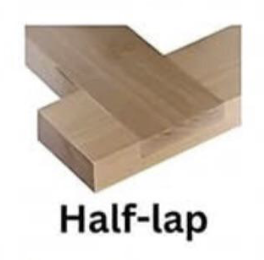
The half lap joint can be very strong with glue and screws.
Are you interested in wood project plans that use different wood joinery techniques?
Over 16,000 woodworking project plans for beginners and experts.
The detailed plans also show blow up details of the different types of wood joinery in addition to all measurements, material and tool lists.
Bridle Joint
The **bridle joint** is like a mortise-and-tenon’s open cousin and is excellent for frames. One piece gets an open-ended mortise (a slot), the other gets a tenon (a tongue) that fits the slot. It’s relatively easy to cut on a table saw or with a router and gives tons of glue surface, plus it self-aligns nicely for square frames.
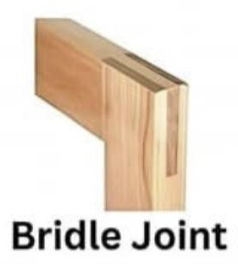
The bridle joint is a strong and attractive joint.
Lots of glue surface makes it super strong and with a good fit, screws can be avoided if you don't want screw marks.
The **rabbet joint** is a simple shoulder cut along the edge of a board so another board nests into it. Construction: cut an L-shaped step using a table saw, router, or rabbet plane; apply glue; clamp or nail. Rabbets are extremely common in boxes, cabinet backs, and drawer construction because they increase glue area and help parts register square.
A close relative is the **dado joint**, a groove cut across the grain to accept another board (like shelves into cabinet sides). Construction: cut a dado with a dado stack, router, or handsaw + chisel; fit the shelf snugly; glue and clamp. Dados are a staple of **joinery techniques in wood working** for cabinets and bookcases because they resist sag and racking.
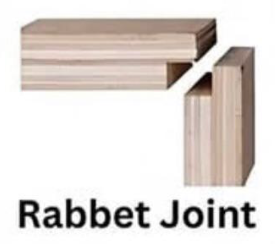
Rabbet Joint. A simple joint that increases glue area making it fairly strong and commonly used in cabinetry.
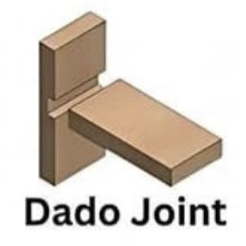
The cuts for Dado joints run across the grain and the variation of Dado called a groove joint is explained below.
Then there’s the **groove joint**, which is like a dado but runs with the grain (often for panels). A classic use is frame-and-panel doors: the frame has grooves that capture a floating panel. Construction: plow a groove with a router or table saw; size the panel to float; assemble the frame with its corner joinery (often mortise-and-tenon). This design handles seasonal wood movement gracefully.
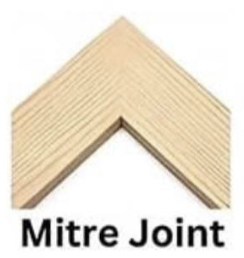
The mitre joint is an attractive joint but not a strong one.
Common for picture frames where strength isn't a big issue.
It can be strengthened with techniques outlined below.
If you want a joint that’s easy *and* looks clean, use the **miter joint**—two boards cut at 45° to form a corner. Great for picture frames and trim, but the end grain glue surface makes it weaker than it looks. Construction: accurate 45° cuts (miter saw or table saw sled), glue, and clamp with a band clamp or miter clamping jig.
To strengthen a miter, you can add **splines**. A spline is a thin strip of wood inserted into a slot cut across the miter. Construction: glue the miter, clamp, cut a kerf across the corner (jig + table saw or router), glue in a spline, then trim flush. This adds long-grain reinforcement and can be decorative if you use contrasting wood.
Another simple reinforcement is the **biscuit joint**. A biscuit joiner cuts matching crescent-shaped slots; compressed beech “biscuits” swell with glue to help alignment. Construction: mark centers, plunge-cut slots, spread glue, insert biscuits, clamp. Biscuits shine at panel glue-ups and alignment; they’re not usually the strongest structural joint by themselves, but they make assembly much easier.
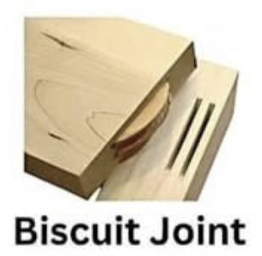
Here's a sample of a biscuit joint. Wood supply stores sell the tools for this job and the different sizes of biscuits that can be used.
They are great for adding more strength to joints such as the corners of picture frames.
Another simple reinforcement is the **biscuit joint**. A biscuit joiner cuts matching crescent-shaped slots; compressed beech “biscuits” swell after glue is applied making the joint tight and immovable. Construction: mark centers, plunge-cut slots, spread glue, insert biscuits and clamp. Biscuits shine at panel glue-ups and alignment; they’re not usually the strongest structural joint by themselves, but they make assembly much easier and more accurate.
If you’re you're looking for strongest the **mortise-and-tenon joint** is at the top of the list. One piece gets a mortise (a rectangular hole), the other gets a tenon (a matching tongue) with shoulders that close the joint. Construction: lay out with a marking gauge, cut mortise (chisel, mortiser, or router), cut tenon (table saw, router, or hand saw), test fit, glue, clamp.
Mortise-and-tenon is the backbone of chairs, tables, doors—anything that takes real stress. Variations include the **haunched tenon** (extra strength near a groove) and the **drawbored tenon** (a peg pulls the joint tight, sometimes even without clamps). If you want a joint that can survive generations, this is one of the best answers.
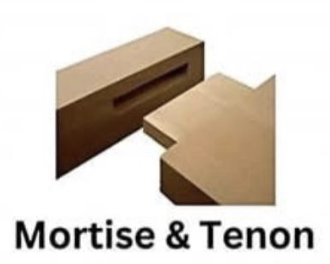
Mortise and Tenon - a super strong joint.
A common furniture joint due to strength and adds to furniture longevity.
iIf you’re chasing “strongest and most respected,” the **mortise-and-tenon joint** is at the top of the list. One piece gets a mortise (a rectangular hole), the other gets a tenon (a matching tongue) with shoulders that register the joint. Construction: lay out with a marking gauge, cut mortise (chisel, mortiser, or router), cut tenon (table saw, router, or hand saw), test fit, glue, clamp.
Mortise-and-tenon is the backbone of chairs, tables, doors—anything that takes real stress. Variations include the **haunched tenon** (extra strength near a groove) and the **drawbored tenon** (a peg pulls the joint tight, sometimes even without clamps). If you want a joint that can survive generations, this is one of the best answers.
The **floating tenon** (often called a loose tenon) is a modern favorite—think “mortise-and-tenon, but easier to machine.” You cut matching mortises in both parts and insert a separate tenon. Construction: rout or plunge-cut mortises (router + jig or a dedicated machine), mill tenon stock, glue, assemble. It’s strong, repeatable, and fantastic for batch building.
Dowel Joint
The **dowel joint** is a classic: round wooden pins connect two boards. Construction: mark hole locations carefully, drill matching holes (a doweling jig helps a lot), add glue in holes and on faces, insert dowels, clamp. Done well, dowels can be very strong because they add mechanical strength and increase glue surface.
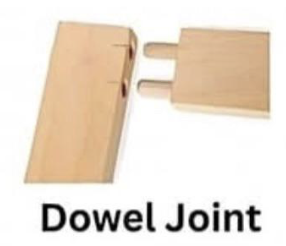
Dowel joints are another common joint. They add more strength because of a much increased glue surface.
A relatively easy joint too if you are new to it!
For serious mechanical lock plus style, you’ve got **dovetail joints**—famous in drawers. The tails and pins interlock so the joint resists being pulled apart. Construction: lay out angles, cut tails and pins (hand saw + chisels, or router jig), test fit, glue lightly, assemble. Dovetails are both strong and a “wow” detail, especially in contrasting woods.
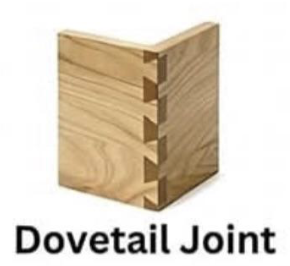
Dovetail joints are attractive and strong. There are different types of jigs available for making these joints making them much easier to build.
A common type of joint in wooden crates.
A simpler cousin of the dovetail is the **box joint** below(finger joint). It’s a set of interlocking square “fingers” that gives lots of glue surface and looks great. Construction: use a table saw with a box-joint jig (or a router jig) to cut evenly spaced fingers, test fit, glue, clamp. For decorative storage boxes, this is one of the most satisfying joints to learn.
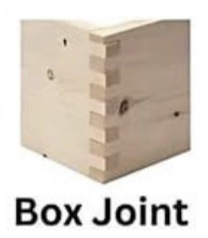
A simpler version of the dovetail, not as strong but easier to make than the dovetail.
It is still a pretty strong joint due to all of the glue surface.
Tongue and Groove Joint
The **tongue-and-groove joint** is everywhere: flooring, paneling, cabinet backs, and wide panels that need alignment. One board has a tongue; the other has a groove. Construction: cut tongue and groove with matched router bits or table saw setups, apply glue only where appropriate (sometimes you let it float), and assemble. It aligns boards while allowing controlled movement in bigger assemblies.
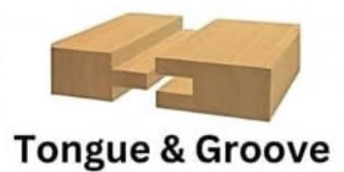
In some cases, you don't glue this joint.
For example, in flooring you want the wood to maintain some flexibility due to a large area of wood expanding and contracting slightly with temperature and humidity changes.
A few “special mention” joints you’ll see a lot: the **housing joint** (a dado variant used in casework) and made just like a dado, the **scarf joint** (joining lengthwise, often in trim or beams), and the **birdsmouth** (roof framing). They’re not always the first joints beginners learn, but they show how many different types of wood joinery exist once you start building real-world projects.
A scarf joint is commonly used for crown moulding and baseboards: A 45-degree angled cut is used to join trim on long walls, creating a seamless appearance.
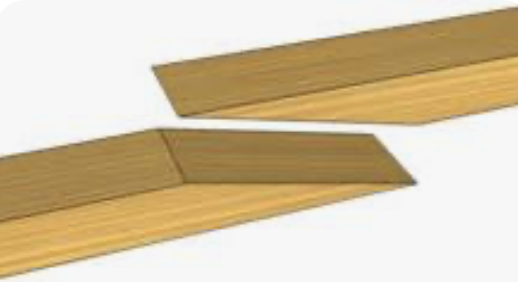
Here is a simple example of a scarf joint, common in crown mouldings and baseboards.
There are other variations of this joint and they are not very commonly used in most woodworking.
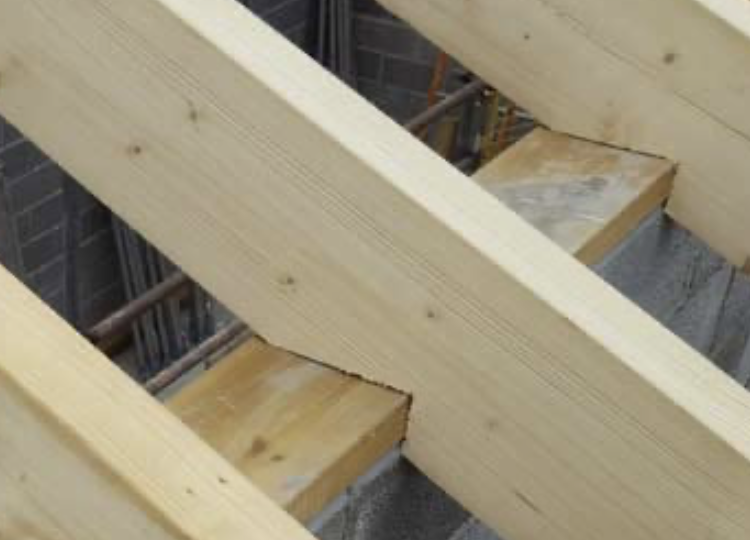
Here's an example of a birds mouth joint.
Commonly used in construction.
This image shows it used in the rafters of a roof.
So which are easiest, strongest, and most decorative? Easiest: butt joints, pocket holes, rabbets, and dados (with the right tools). Strongest: mortise-and-tenon, well-made dowels, dovetails, and strong lap/bridle joints in frames. Decorative: dovetails, box joints, splined miters, and contrasting plugs—these are the joints that make people stop and look.
If you want a practical way to learn **different types of wood joinery**, pick one small project and intentionally choose one new joint for it—like a small box with a rabbeted back, a shelf with dados, or a drawer with box joints. That’s exactly why good woodworking plans are so valuable: they guide you through the right joint for the job, list the cut sequence, and help you build confidence from beginner builds all the way up to advanced furniture-grade joinery.
Click here to see information on tools for wood joinery.